

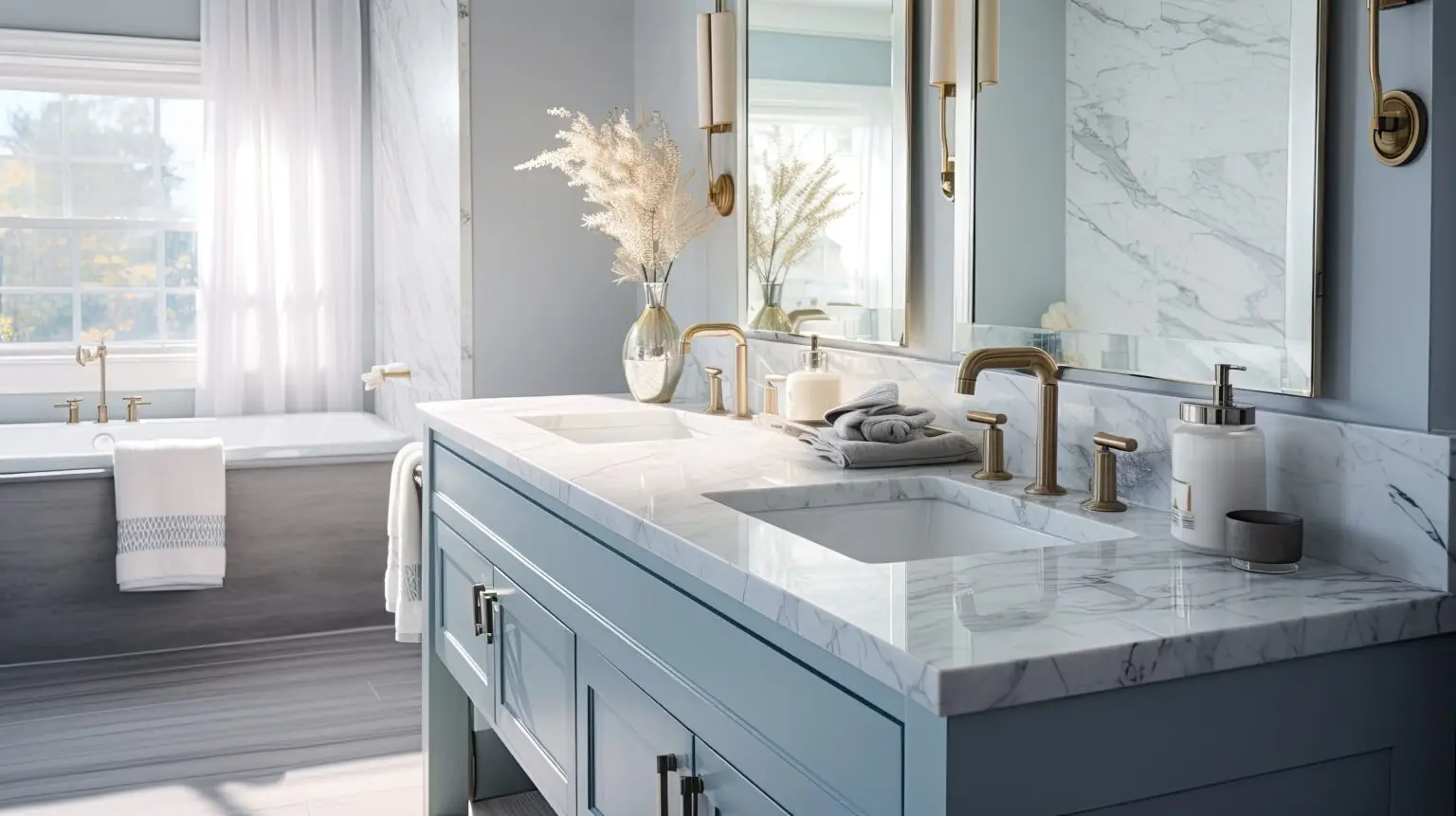
When choosing between granite and marble, you aren’t just choosing a countertop; you are choosing the personality of your kitchen. Both are stunning, natural stones quarried from the earth, but they have completely different chemical makeups, which dictates how they perform in the daily chaos of a busy home.
At GS Kitchen & Bath, we want you to love your surfaces for years to come. Understanding the “personality” of these stones is the key to a happy long-term relationship with your kitchen.
Granite and Marble: Key Differences
- Granite is an igneous stone, formed deep within the earth by cooling magma. It is an incredibly dense, tightly-packed mosaic of minerals like quartz and mica, which gives it its signature speckled or granular appearance.
- Marble is a metamorphic stone, formed when limestone is subjected to intense heat and pressure. It is primarily composed of calcite, which is a softer mineral. This formation process creates marble’s famous soft, dramatic, and elegant veining.
Durability Comparison
- Granite: The heavy hitter. On the Mohs Scale of Hardness (1–10), granite typically scores a 6 or 7, making it remarkably hard and resistant to scratches from standard kitchen knives or everyday cookware.
- Marble: The delicate beauty. Scoring a 3 or 4 on the Mohs scale, marble is significantly softer. It is prone to scratching, chipping at the edges, and developing a “patina” (a soft, lived-in look) over time.
Stain and Scratch Resistance
- Granite: Highly resistant to both. Because it is so dense, it doesn’t absorb liquids easily. While you should always use a cutting board, granite can handle a accidental slip of the knife without a scratch.
- Marble: Highly vulnerable. Marble is porous and reactive. It is particularly susceptible to etching—dull spots caused by acids like lemon juice, vinegar, wine, or tomato sauce. If a spill isn’t wiped up immediately, it will leave a mark.
Maintenance and Sealing Needs
- Granite: Low maintenance. It requires sealing, but usually only every 1–3 years depending on usage. It is the forgiving, “set it and forget it” natural stone.
- Marble: High maintenance. It requires diligent, frequent sealing (often every few months or annually) to maintain its stain resistance. Owners must also be comfortable with the fact that marble will eventually etch—it is part of the material’s unique character.
Cost Differences
Generally, marble is the more expensive investment. Its rarity, the prestige of the look, and the specialized labor required for precision fabrication contribute to the higher price tag. Granite is widely available and typically offers a more affordable entry point for natural stone, though premium, exotic granite slabs can rival the price of marble.
Which Stone Is Better for Kitchens?
- Choose Granite if: You have a high-traffic kitchen, a busy family, or you prefer a surface that requires minimal worry. It handles the “battle” of daily cooking with grace and ease.
- Choose Marble if: You are a dedicated home cook or baker who loves the specific performance of marble (it stays naturally cool, which is perfect for dough), or if you prioritize the unique, high-end aesthetic over low maintenance. If you choose marble, you must be the type of homeowner who enjoys the natural aging process of the stone.
FAQ
Is granite better than marble?
In terms of pure durability and low maintenance, yes, granite is objectively “better” for kitchens. Marble is only “better” if your primary goal is timeless, classic aesthetics and you are willing to accept the high maintenance and natural aging that comes with it.
Does marble stain easily?
Yes. Because marble is porous and calcium-based, it absorbs liquids quickly and reacts chemically (etches) when exposed to acids. Without frequent sealing and immediate spill cleanup, it will stain much more easily than granite.
Which countertop lasts longer?
Granite lasts longer in its “pristine” state. While both materials can technically last for generations, a granite countertop will look new for decades with minimal effort, whereas a marble countertop will show the history of every meal prepared on it.
Is marble worth it in a kitchen?
If you are a design enthusiast who loves the “patina” of natural stone and can embrace the inevitable etching, then yes. If you want your kitchen to look exactly as it did on installation day for the next 20 years, marble is likely not the right choice.
Ready to find the stone that suits your lifestyle?
At GS Kitchen & Bath, we provide expert guidance on material selection to ensure your countertops balance beauty with your daily habits.
Schedule your design consultation with GS Kitchen & Bath today!