

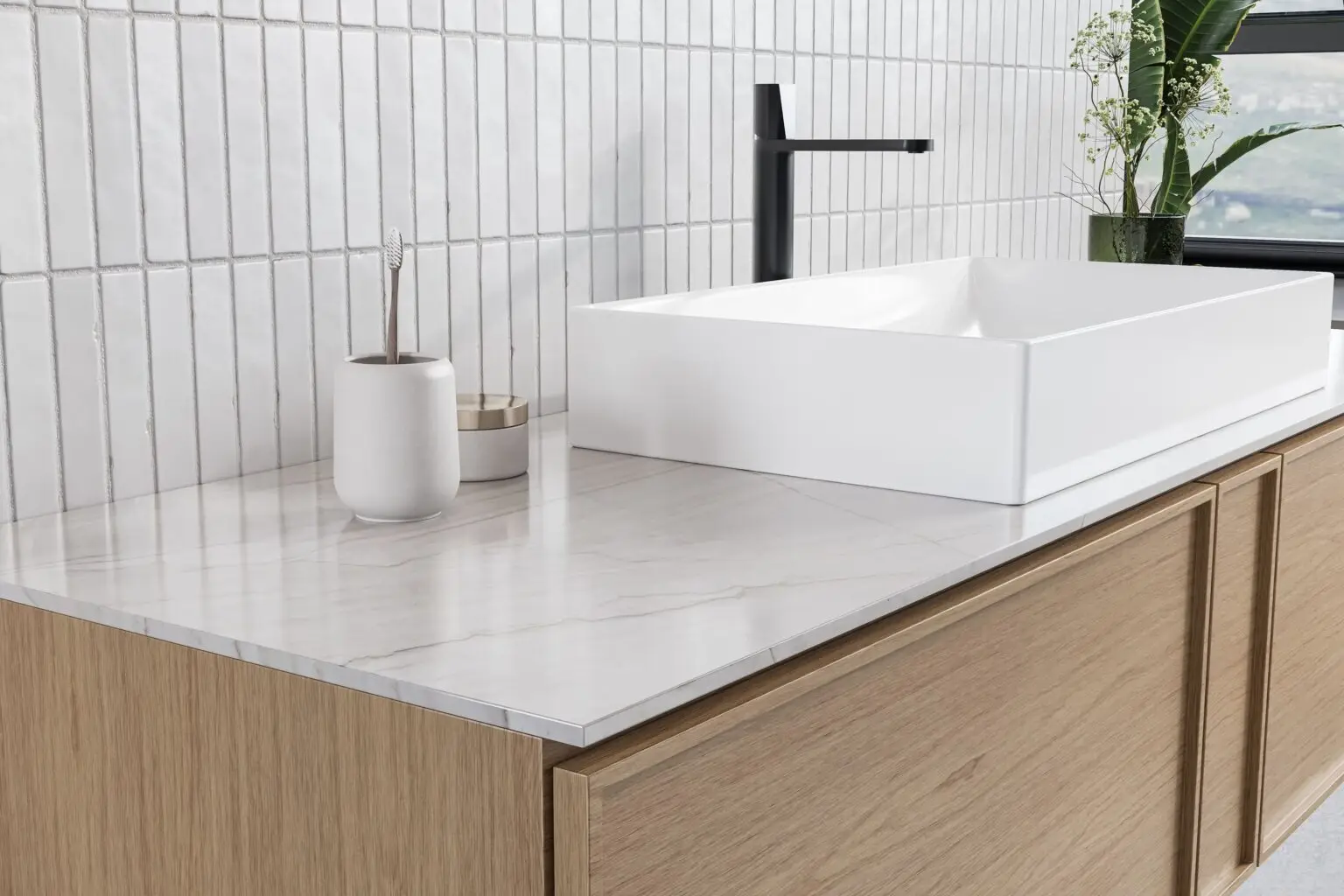
When designing your dream kitchen or bath, thickness is often the most overlooked design detail. It influences the durability of the stone, the structural requirements of your cabinetry, and the overall visual “heft” of your kitchen. At GS Kitchen & Bath, we believe that thickness isn’t just a technical specification—it’s a design choice that defines whether your kitchen feels sleek and modern or substantial and traditional.
Quick Answer: What Countertop Thickness Is Best?
For the vast majority of kitchen remodels in the U.S., 3cm (approx. 1 ¼ inches) is the gold standard. It provides the perfect balance of structural integrity, aesthetic presence, and ease of installation. While 2cm (approx. ¾ inch) is common in bathrooms and some European-style designs, 3cm is the preferred choice for kitchen durability and impact resistance.
Why Countertop Thickness Matters
Thickness affects two primary factors: support and aesthetics.
- Structural Support: Thicker stone is stronger and less prone to cracking over large spans (like an island or dishwasher gap).
- Visual Weight: A thicker edge profile makes a countertop look “expensive” and substantial. A thin edge, conversely, looks minimalist and light.
Common Countertop Thickness Options
2cm (3/4 Inch)
Often found in bathroom vanities or as a standard in some markets, 2cm stone is thinner and lighter. It is cost-effective, but because it is prone to cracking, it almost always requires a plywood sub-top (a layer of wood beneath the stone) for support.
3cm (1 1/4 Inch)
The standard for high-quality American kitchens. It is thick enough to support its own weight over standard dishwasher openings and cabinet spans, typically eliminating the need for a plywood sub-top.
Thicker Built-Up Edges (Mitered)
If you want the “chunky” designer look (where the counter looks 3 to 4 inches thick), we create a “mitered edge.” This involves cutting a thin piece of stone at a 45-degree angle and bonding it to the edge of the countertop. It creates a seamless, monolithic look that is currently very popular in modern design.
Countertop Thickness by Material
- Quartz: Highly versatile. It is available in both 2cm and 3cm. Because quartz is engineered, it is less prone to cracking than natural stone, making 2cm a safer bet here than with natural granite.
- Granite: Naturally brittle. We almost always recommend 3cm for granite to prevent fractures in high-traffic kitchen areas.
- Marble/Quartzite: These are soft or natural stones that can be more prone to cracking. 3cm is the professional recommendation for these materials to ensure long-term stability.
2cm vs. 3cm: The Comparison
| Feature | 2cm (3/4″) | 3cm (1 1/4″) |
| Plywood Sub-top | Required | Optional/Not needed |
| Durability | Moderate | High |
| Cost | Lower | Higher |
| Look | Minimalist/Sleek | Substantial/Premium |
Countertop Thickness for Kitchen Islands
For a large kitchen island, go with 3cm. Islands are the primary work area where people lean, sit, and place heavy appliances. The extra thickness provides the rigidity needed to ensure the stone doesn’t sag or fracture over time. If you want a “thick” look for a luxury island, we recommend a mitered edge to maintain that sense of scale.
Does Countertop Thickness Affect Cost?
Yes. Thicker slabs (3cm) are more expensive to purchase, transport, and install due to their weight. However, 2cm countertops often require a plywood sub-top and extra labor to fabricate the edge, which can sometimes bridge the cost gap. Always look at the total installed price rather than just the raw material cost.
FAQ
Is 2cm or 3cm countertop better?
For kitchens, 3cm is better. It is stronger, more durable, and doesn’t require a plywood sub-top, giving you a cleaner finish inside your cabinets.
What is standard countertop thickness?
In the United States, the industry standard for kitchen countertops is 3cm (1 ¼ inches).
Does thicker countertop mean better quality?
Not necessarily “quality,” but it usually means better durability. A thicker slab will withstand the rigors of a busy kitchen much better than a thinner slab.
What thickness is best for quartz countertops?
We recommend 3cm for a kitchen. If you are doing a small, low-traffic bathroom vanity, 2cm is perfectly fine.
Does countertop thickness affect price?
Yes. Thicker slabs are heavier and carry a higher material cost. However, the difference is often offset by the fact that 3cm doesn’t require the extra labor of installing a plywood sub-top.
Need help deciding on the perfect edge and thickness for your kitchen?
At GS Kitchen & Bath, we provide full-service countertop installation, from slab selection to custom edge fabrication. Contact us today to schedule your design consultation and see our stone samples in person!